
System Guides
Louvered Pergola Maintenance: Cleaning, Drainage and Seasonal Care
Plan louvered pergola maintenance with practical guidance on cleaning, gutters, coatings, controls, seasonal checks and service records.

DIRECT ANSWER
What maintenance does an aluminum louvered pergola need?
Maintain a louvered pergola by following the selected system’s instructions for coating care, cleaning, drainage checks, roof operation and service access. Keep accessible collection paths clear using approved methods, observe changes in movement or drainage, and record problems for the supplier. Motorized roofs and accessories require their own equipment guidance. Set inspection frequency around the manual and local exposure, including nearby trees, dust and coastal deposits. Routine owner care should be distinguished from electrical, structural and mechanism repairs.
WHO THIS GUIDE IS FOR
Use this guide to frame the right project questions.
- Homeowner planning routine care
- Restaurant operator coordinating a terrace
- Facilities team maintaining an outdoor amenity
- Installer preparing a clear owner handover
Start with the exact system and its care instructions
A louvered pergola combines a coated structure with roof blades, joints, drainage paths and, in a motorized configuration, a drive and controls. Optional side systems introduce further equipment. Prepare a record of the model, approved configuration, installation date and supplier contact. Keep the operation and care instructions with that record so the person arranging maintenance can identify which guidance applies.
General advice is useful for organizing care, but the selected equipment instructions establish the approved cleaners, isolation method, service tasks and weather operation rules. Ask for clarification where the handover is incomplete. A generic online guide cannot determine which lubricant, electrical procedure or roof position is appropriate for every system. This article is a planning guide, not a replacement for the manual supplied with your pergola.
Set a care schedule around exposure and use
Begin with the manufacturer’s schedule and then consider the conditions around the structure. Trees can introduce leaves and seed debris, nearby work can create dust, and a busy hospitality setting can make unnoticed faults more disruptive. Add a visual check after unusual debris accumulation or a reported operating problem. The purpose is to identify changes early and arrange the appropriate response, rather than assume that every location needs the same interval.
Renson’s public maintenance guidance illustrates that aluminum pergolas still need regular care, although its products and maintenance conditions apply to its own systems. Use that as general industry context only. For a JY Outdoor Pergola installation, request instructions matched to the selected configuration and environment. Record who is responsible for routine checks and who can authorize specialist work, particularly where the owner, tenant and operator are different parties.
Prepare a compatible cleaning method
Before cleaning, identify the finish and read its care requirements. Use only products and tools approved for the surfaces being treated. A product suitable for glass or paving is not automatically suitable for a coated aluminum profile, screen fabric or seal. Avoid experimenting on visible surfaces with strong chemicals, abrasives or unapproved pressure-cleaning equipment. Ask the supplier how to handle persistent staining rather than escalating to a harsher method without guidance.
Plan access and protect nearby equipment before work starts. Keep people and furniture clear of the cleaning area, follow the specified power isolation procedure for motorized equipment, and keep hands clear of moving parts. Do not use roof blades or the pergola frame as an improvised access platform. Where safe access is unavailable from the ground or an approved arrangement, use a competent maintenance provider instead of extending the routine task into roof work.
Treat gutters and outlets as part of the care plan
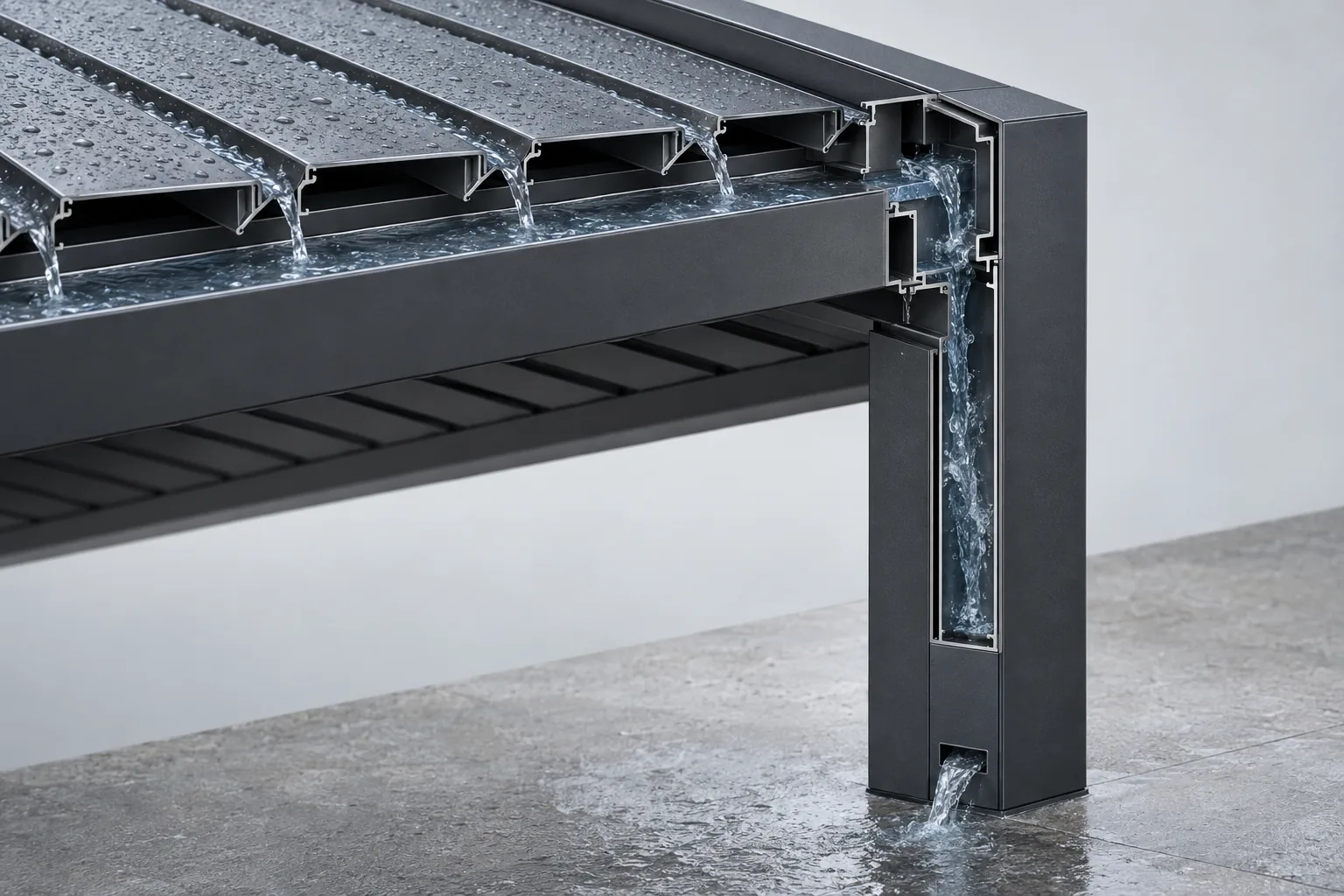
A clean exterior does not establish that the water path is clear. Review the collection and discharge arrangement shown in the system information: water may travel from closed louvers into perimeter channels and then through designated outlets or posts. Identify which parts are intended to be owner-accessible and which need service access. Clear accessible debris only by the approved method and arrange assistance for concealed or obstructed areas.
During normal rain, note where water appears and whether its path has changed. Record the louver position, weather conditions and location of any overflow or persistent dripping. An outlet discharging onto a poorly drained paved area is a different issue from a blocked collection channel or an interface problem. Describe the observation precisely so the supplier and site team can distinguish system care from the external drainage arrangement.
Observe roof movement without adjusting the mechanism
A useful owner check is an observation made during normal permitted operation. Look for a change from the established behavior, such as uneven movement, a repeated stopping point or a new sound. Keep the movement zone clear and stop operating if there is an obstruction, visible damage or an unexplained fault. Do not repeatedly cycle a struggling mechanism in the hope that the problem will disappear.
Record the symptoms, control used and any recent event, such as cleaning, power interruption or severe weather. Photographs or a short recording from a safe position can help a service contact understand the issue. Do not open electrical enclosures, change drive settings, force blades into position or apply lubricant without the relevant instructions. Those actions can complicate diagnosis and should be handled through the approved service route.
Maintain each accessory according to its own instructions
ZIP screens, glazing, lighting, heaters and fans should be recorded as separate equipment within the owner’s asset list. Keep their identification and care documents together with the main pergola information. Fabric, glass, coated profiles and electrical components have different cleaning needs. A single routine applied to every surface can overlook the requirements of the accessory or its mounting interfaces.
Check that ordinary use and furniture placement leave the intended movement and service areas clear. Report damaged screen fabric, unusual tracking, loose visible parts or changes in accessory operation through the designated service contact. Where an accessory has a separate isolation or commissioning procedure, keep it available to the maintenance provider. Do not assume that a roof weather sensor also provides every protective function for side equipment.
Prepare for seasonal changes using the system rules
Before a change in season, review the operating instructions and any local exposure issues. Remove accessible accumulated debris by the approved method, confirm that service access remains usable and check that responsible staff know how to stop normal operation. Where the manual specifies a weather position or operating restriction, follow the instruction for that exact roof and accessory configuration.
There is no universal instruction to leave every louvered roof open or closed during wind, snow or frost. Do not force a mechanism that appears frozen or obstructed. Weather sensors should be used within their documented scope and do not replace the required operating rules. After a significant event, report visible distortion, displaced parts or changed performance before resuming operation where safety or condition is uncertain.
Create a service report that helps diagnosis
When an issue appears, record the model and location first, followed by the exact symptom and the time it was observed. For a drainage concern, show the point where water appears and the external discharge area. For a movement concern, describe which part stops or behaves differently. Include any error indication exactly as displayed. Avoid diagnosing a motor failure or a leaking roof joint from a symptom that could have several causes.
Ask the service contact what checks the owner is authorized to perform and what should remain undisturbed until inspection. If the issue affects safe use, keep the area or equipment out of use as appropriate to the instructions received. Save the service outcome with the maintenance log so a recurring problem can be compared with the earlier record instead of being treated as an unrelated new report.
Make the handover useful for the next owner or operator
A useful handover contains the selected configuration, operation instructions, care methods, accessory documents, warranty terms and the service contact route. Add a simple maintenance log with date, observation, work performed and the person responsible. Keep photographs of the original completed arrangement where available, clearly distinguished from concept illustrations. These records help later teams understand what was supplied and what has changed.
For commercial premises, make a short operational briefing part of staff induction. Explain normal controls, movement clearances, reporting procedures and who arranges maintenance. The facilities team should retain the more detailed technical records. This division gives everyday users the information they need while keeping repairs and adjustments with the responsible provider. Ask for the handover package before purchasing so ownership care is part of the project scope from the beginning.
COMPARISON
Routine observations and the appropriate next step
Use this table to structure a discussion, not as project approval.
| Observation | Information to record | Response |
|---|---|---|
| Accessible debris | Location and any blocked visible path | Use the approved cleaning method |
| Changed water path | Rain conditions, roof position and outlet location | Request review of drainage and interfaces |
| Unusual movement | Affected area, control used and displayed indication | Stop repeated operation and contact service |
| Coating damage | Location, photographs and known cause | Ask for an approved repair method |
| Visible distortion after weather | Photos from a safe location and event details | Arrange inspection before uncertain equipment is used |
PROJECT CHECKLIST
Information to prepare
- Model, configuration and supplier contact
- Operation and care instructions
- Approved surface cleaning products and tools
- Specified isolation and safe access arrangements
- Accessible collection channels and outlet locations
- Accessory identification and care documents
- Seasonal operating rules for the installed equipment
- Warranty terms and reporting procedure
- Maintenance log with photographs where helpful
- Responsible owner, operator and service provider
COMMON PLANNING MISTAKES
Assumptions to avoid
- Assuming an aluminum structure makes the whole system maintenance-free
- Using a cleaner or pressure method without checking compatibility
- Standing on louvers to reach a cleaning area
- Forcing obstructed blades or repeatedly cycling a fault
- Applying another brand’s weather operating rules to the installed system
- Adjusting electrical or mechanical components without approved instructions
FAQ
Questions about louvered pergola maintenance
How often should I clean an aluminum pergola?+
Use the installed system’s care schedule and adjust inspections for local debris, dust, coastal exposure and use. Ask the supplier for a suitable routine rather than assuming one interval fits every site.
Can I use a pressure washer on pergola louvers?+
Only where the manufacturer explicitly permits the equipment and method for the relevant surfaces and components. Otherwise request an approved cleaning method.
Should I lubricate a motorized pergola?+
Apply lubricant only where the equipment instructions identify an approved product, point and procedure. Do not spray an unidentified product into the drive, pivots or electrical equipment.
Why is my pergola gutter overflowing?+
Possible issues include debris, an outlet restriction, installation conditions or the external discharge arrangement. Record where overflow appears and request a review; the symptom alone does not identify the cause.
Should louvers be open during snow or strong wind?+
Follow the exact model and accessory instructions. Roof behavior and restrictions differ, so a universal open-or-closed recommendation is not appropriate.
What should I do if the roof stops moving?+
Keep the movement zone clear, stop repeated operation and follow the documented fault procedure. Report the model, symptom, control used and any error indication to the service contact.
SOURCES AND FURTHER READING
NEXT STEP
Plan your pergola configuration
For a new project, share your site conditions and required equipment so care and service access can be considered during configuration review.
Plan your pergola configuration