
Pergola Comparisons
Pergola Roof Types Compared: Louvered, Retractable, Fixed and Polycarbonate
Compare louvered, retractable fabric, fixed solid and polycarbonate pergola roofs by shade, daylight, rain strategy, ventilation and maintenance.
DIRECT ANSWER
Which type of pergola roof is best?
The best pergola roof is the one whose behavior matches the intended space and site. Rotating aluminum louvers adjust shade and ventilation while remaining over the opening. A retractable roof moves fabric or roof elements toward a storage zone to reveal more open sky. A fixed solid roof provides one continuous overhead condition, while polycarbonate can admit daylight through a fixed panel. Compare rain strategy, heat and daylight, movement, drainage, structural support, maintenance, noise, appearance and local requirements before comparing price.
KEY TAKEAWAYS
The working principles in brief
- Choose the required roof behavior before choosing a material or model.
- Adjustable, retractable and fixed roofs create different outdoor experiences.
- Every covered roof needs a defined water and support strategy.
- Compare complete installed scopes, not roof panels alone.
WHO THIS GUIDE IS FOR
Use this guide to frame the right project questions.
- Homeowner deciding how much open sky and shade is needed
- Designer comparing daylight, ventilation and roof appearance
- Commercial buyer comparing complete operating and maintenance scopes
Start with roof behavior, not a material list
Before reviewing products, write what the roof should do during a normal day. Does the space need adjustable shade, a broad open-sky condition, constant translucent cover or a visually solid ceiling? Is ventilation through the roof important? Will staff or residents change the roof often, and what should happen during rain or strong weather? A material can appear in several different assemblies, so choosing aluminum, fabric or polycarbonate alone does not define the experience. Record the occupied hours, sun direction, views, furniture and tolerance for changing conditions. This behavior brief creates a fair basis for comparing roof systems that otherwise solve different problems.
Rotating louvers balance adjustable shade and ventilation
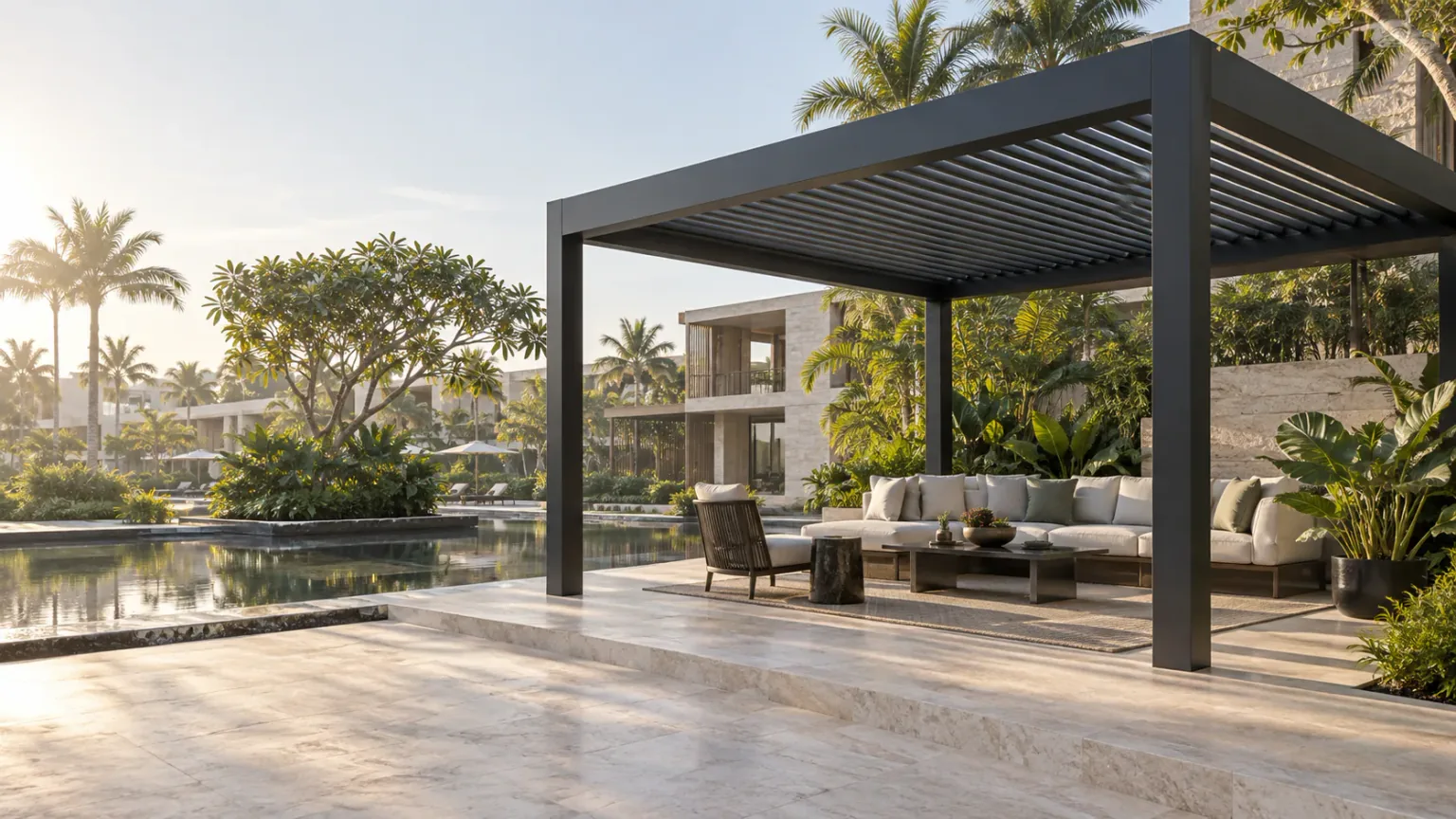
A louvered roof uses repeated blades that rotate within a supporting frame. Open and intermediate positions allow varying amounts of daylight and air through the roof; a compatible closed position can form part of a coordinated rain-management path. The blades remain above the covered area, so the view becomes an ordered ceiling rather than a fully open rectangle. Buyers should compare louver depth, movement, module layout, controls, drainage, perimeter beams and maintenance access. Avoid assuming that every louvered product has the same rotation, sealing concept or verified performance. The specific model and site configuration determine what the roof can reasonably be expected to do.
Retractable roofs prioritize a larger open-sky condition
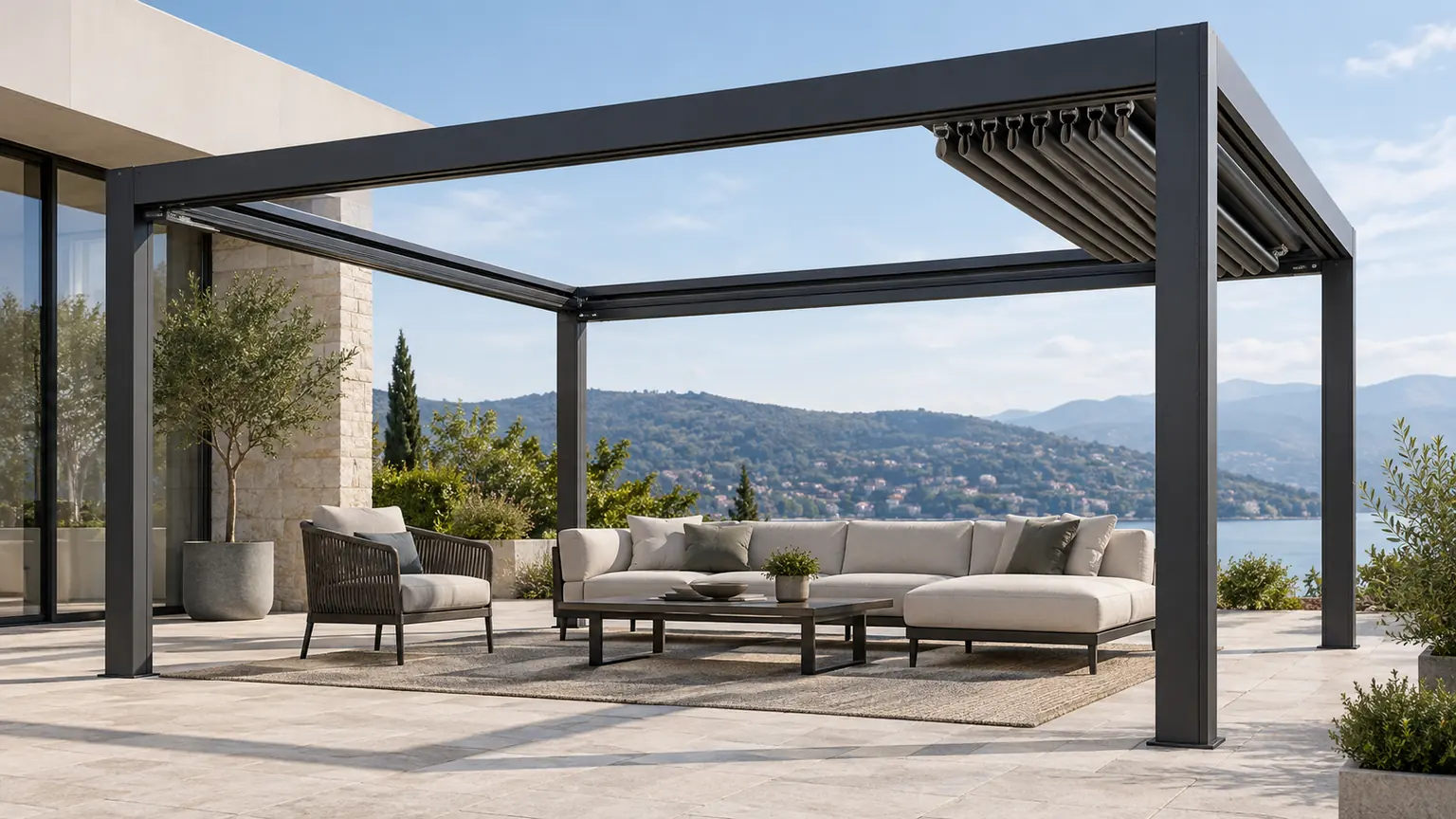
A retractable roof moves its covering toward a planned storage or stacking zone. Depending on the system, the moving element may be fabric, folding blades or another panel arrangement. This can reveal more sky than rotating louvers, but it introduces a travel path, a retracted stack, guides, motors or tensioning components and a different drainage strategy. Ask where the stack sits, how much opening remains, what happens to water, which positions are permitted and how the system is accessed for service. Do not confuse a retractable fabric canopy with a retractable aluminum blade system merely because both open; their materials, mechanics and operating limits may differ substantially.
A fixed solid roof keeps one overhead condition
A fixed roof may suit a brief that values continuous overhead coverage and does not need adjustable sun or open sky. Its apparent simplicity does not remove structural, drainage, condensation, heat or building-interface questions. The roof still requires a defined slope or water-management arrangement, suitable support, perimeter details and a destination for discharge. Depending on materials and insulation, the underside temperature, sound during rain and daylight level can differ from an operable roof. Compare the complete construction rather than describing fixed as automatically cheaper, stronger or more waterproof. Those outcomes depend on the actual assembly, span, supports and site work.
Polycarbonate admits daylight through a fixed sheet system
Polycarbonate panels are available in different structures, colors, coatings and light-transmission characteristics. They can provide a lighter visual roof while retaining daylight, but the result depends on the exact sheet, orientation, support spacing, joints, edge closures, thermal movement and cleaning access. Use the panel manufacturer documentation for the selected product instead of generic claims about all polycarbonate. A clear panel may increase solar gain or reveal dirt differently from an opal or tinted panel. Ask how the sheet interfaces with the pergola frame, how expansion is accommodated and how rain reaches the gutter without relying on field improvisation.
Compare shade, heat, daylight and ventilation together
A roof that admits abundant daylight can still create glare or heat at an occupied table, while a visually solid roof can make a room beside it feel darker. Adjustable louvers offer a way to change the balance, but their useful effect depends on orientation, season, roof height and the sun entering through open sides. Retracting a roof can release trapped heat and reveal sky, but only when the weather and operating rules permit. Test the decision against morning, afternoon and evening use rather than one attractive photograph. If the pergola adjoins interior windows, include the effect on those rooms in the comparison.
Rain strategy and sound depend on the complete assembly
Fixed panels, closed louvers and tensioned or folding roofs handle water in different ways. Ask how water is collected, how joints are arranged, which roof positions manage rain and where discharge occurs. Also discuss the acoustic context. Rain on a rigid panel, movement of a fabric membrane and operation of a motorized mechanism produce different sounds; the surrounding walls and occupied use affect whether those sounds matter. No roof type should be called silent or universally waterproof without defined evidence. For a restaurant or bedroom-adjacent terrace, include expected operating hours and sensitivity in the design brief.
Compare complete installed and maintained scopes
A useful comparison includes frame, roof, controls, drainage, supports, electrical work, building interfaces, finishes, delivery, installation, commissioning and maintenance access. An apparently lower-cost roof may exclude the structure or site work needed to make it usable; a more complex roof may provide flexibility the project does not value. Request itemized proposals against the same footprint and behavior brief. Keep local permits and professional services visible. Finally, compare ownership tasks: cleaning panels, clearing gutters, inspecting fabric, servicing drives or maintaining finishes. The best roof is not the one with the longest feature list but the one whose benefits and obligations match the owner.
Before deciding, ask each supplier to show the proposed roof in plan and section, including open and closed positions, support locations, water routes and service zones. Then review the same ordinary day: morning light, occupied lunch, an afternoon shower and evening cleaning or closure. This scenario method exposes differences that specification tables can hide and keeps the final choice connected to real use rather than category labels.
If the project remains undecided, keep two clearly described options instead of blending their best features into an imaginary roof. Price and review each option with its real structure, controls, drainage and exclusions. A transparent comparison can reveal that the added flexibility of one system is valuable in one zone but unnecessary in another, allowing a mixed site strategy without confusing product capabilities.
COMPARISON
High-level roof behavior comparison; exact products vary.
Use this table to structure a discussion, not as project approval.
| Roof concept | Primary benefit | Key verification |
|---|---|---|
| Rotating aluminum louvers | Adjustable shade and ventilation | Blade movement, drainage, controls and modules |
| Retractable fabric or panels | Larger open-sky condition | Stack, guides, tension, weather limits and service |
| Fixed solid roof | Continuous overhead condition | Water path, heat, structure and interfaces |
| Polycarbonate panels | Fixed cover with transmitted daylight | Sheet specification, expansion, support and joints |
| Open rafters or slats | Architectural definition with partial shade | Actual shade pattern and lack of rain cover |
PROJECT CHECKLIST
Information to prepare
- Define shade, daylight, open-sky and rain priorities.
- Record when and how often the roof will move.
- Compare the roof in open, intermediate and closed conditions.
- Ask for the water path and final discharge responsibility.
- Review roof effects on adjacent interior daylight and heat.
- Include frame, controls, electrical work and site interfaces.
- Confirm product-specific operating and maintenance instructions.
- Compare itemized installed scopes for the same project brief.
COMMON PLANNING MISTAKES
Assumptions to avoid
- Choosing a roof material before defining the desired behavior.
- Calling every operable roof a louvered pergola.
- Comparing equipment prices while excluding structure and site work.
- Assuming translucent cover creates comfortable daylight in every climate.
- Ignoring the retracted stack, service route or drainage destination.
FAQ
Questions about pergola roof types
Is a louvered roof better than polycarbonate?+
Neither is universally better. Louvers offer adjustable roof conditions; polycarbonate provides a fixed daylight-transmitting cover. Compare heat, light, ventilation, rain strategy, structure, maintenance and the actual site.
What is the difference between louvered and retractable roofs?+
Louvers rotate while remaining over the space. A retractable roof moves material or panels toward a storage zone, usually revealing a larger open area.
Which pergola roof gives the most light?+
The answer depends on material transmission, tint, open area, orientation, season and surrounding buildings. More transmitted light does not automatically mean better occupied comfort.
Which roof is easiest to maintain?+
Maintenance depends on the product and exposure. Fixed sheets, fabric, louvers, gutters and drives each have different cleaning, inspection and service tasks. Review the selected instructions before deciding.
Can I add a solid roof to an existing pergola?+
Only after the existing structure, supports, connections, drainage and local requirements are reviewed for the added roof. An open frame should not be assumed suitable for new loads.
How should I compare roof quotations?+
Give suppliers the same footprint and behavior brief, then compare frame, roof, controls, drainage, electrical work, interfaces, installation, exclusions, maintenance and documentation.
SOURCES AND FURTHER READING
NEXT STEP
Compare roof configurations
Share the intended use, daylight and rain priorities, dimensions and site context to compare suitable roof behaviors.
Compare roof configurations