
Pergola Comparisons
Louvered vs. Retractable Roof Pergolas
Compare rotating louvered and retractable roof pergolas by opening behavior, shade, ventilation, rain management, movement space and project planning.
DIRECT ANSWER
What is the difference between a louvered pergola and a retractable roof pergola?
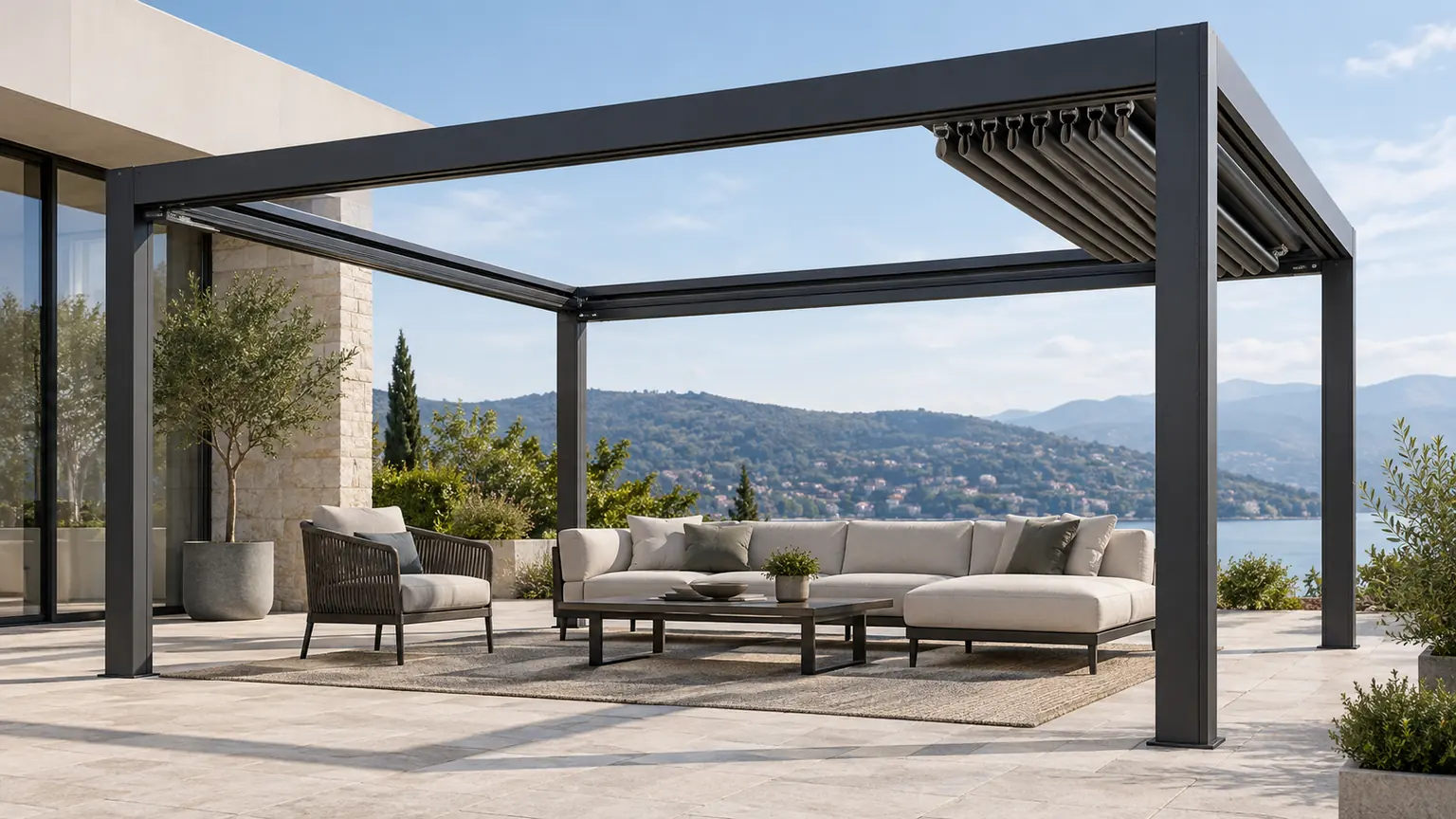
A rotating louvered pergola changes the angle of parallel roof blades to balance shade, daylight and ventilation. A retractable roof pergola moves roof elements away from part of the covered area to create a larger open-sky opening. Both require coordinated frame, movement and rainwater planning. Choose by the desired opening experience, movement clearance, controls, application and project constraints rather than treating one mechanism as universally better.
WHO THIS GUIDE IS FOR
Use this guide to frame the right project questions.
- Buyer comparing roof movement
- Architect defining open-sky intent
- Hospitality planner managing shade
- Contractor coordinating movement space
The roof opens in different ways
Rotating louvers remain distributed across the roof while changing angle. Their positions affect shade, ventilation and views through the blade spacing.
A retractable system moves roof elements toward a collection zone. This creates a different spatial effect and requires clear travel paths, guide alignment and space for the retracted roof arrangement.
Define the desired outdoor experience
If the priority is adjustable overhead shade with the roof elements remaining in place, rotating louvers may be the relevant concept. If a broader open-sky area is central to the experience, a retractable concept may be worth reviewing.
Furniture, trees, façades and views can influence which movement feels appropriate. Consider the roof in both open and closed positions.
Rain management is system-specific
Closed-roof rain management depends on the selected system, drainage layout, installation and weather conditions. Neither mechanism should be described as universally waterproof.
Review how water is collected, transferred through the frame and discharged at the site. Movement zones and seals should be understood from verified system information.
Coordinate movement, controls and access
Manual or powered operation depends on the product concept. Powered systems require electrical and control planning, while all moving systems require unobstructed operation and access for inspection.
Final selection should use model-specific documentation and project review, not a general comparison article as an engineering approval.
COMPARISON
Roof mechanism comparison
Use this table to structure a discussion, not as project approval.
| Decision factor | Rotating louvers | Retractable roof |
|---|---|---|
| Open behavior | Louvers rotate while remaining over the area | Roof elements move toward a retracted zone |
| Open-sky effect | Filtered opening between angled blades | Larger portion of roof area can open |
| Key clearance | Blade rotation and frame interfaces | Travel path, guides and retracted collection zone |
| User objective | Adjust shade, daylight and airflow | Change between covered and more open overhead space |
| Project review | Louver, drive and drainage coordination | Movement, guides, controls and drainage coordination |
PROJECT CHECKLIST
Information to prepare
- Describe the desired open-roof experience
- Show important views and adjacent façades
- Confirm movement clearance
- Review power and control expectations
- Identify drainage destination
- Check accessory conflicts
- Compare model-specific documentation
COMMON PLANNING MISTAKES
Assumptions to avoid
- Treating retractable and rotating as the same movement
- Choosing from the closed appearance only
- Ignoring the retracted collection zone
- Assuming rain performance is identical
- Forgetting control and maintenance access
FAQ
Questions about louvered pergola vs retractable roof pergola
Do rotating louvers create a fully open roof?+
They create openings by changing blade angle, but the louvers remain over the area.
Does a retractable roof disappear completely?+
The roof elements move toward a collection zone; the exact open area depends on the selected system.
Which roof is better for ventilation?+
Both can change the overhead condition, but the useful result depends on opening behavior, site and user priorities.
Are both types motorized?+
Operation depends on the selected product. Confirm manual or powered operation and control requirements for the model.
Which is better in rain?+
There is no universal answer. Rain management depends on system design, drainage, installation and conditions such as wind-driven rain.
NEXT STEP
Compare models
Compare real roof mechanisms and then share the application and desired opening behavior.
Compare models