
Pergola Comparisons
Louvered Pergola vs Retractable Awning
Compare a louvered pergola with a retractable fabric awning: roof movement, shade, supports, rain limitations, controls, maintenance and complete project scope.
DIRECT ANSWER
Should I choose a louvered pergola or a retractable awning?
Choose by the required roof behavior and site arrangement. A louvered pergola adjusts blades within a supporting frame; a retractable fabric awning deploys a canopy from its storage position. An awning can suit a brief focused on deployable shade, while a pergola can suit a defined outdoor zone with compatible accessories. Neither choice removes the need to review attachment, exposure, operation and maintenance. Compare the selected products and installed scopes, not category-wide promises about price or weather resistance.
WHO THIS GUIDE IS FOR
Use this guide to frame the right project questions.
- Homeowner considering patio shade
- Designer assessing facade and terrace interfaces
- Buyer comparing motorized outdoor systems
Distinguish an awning from a retractable pergola roof
The word retractable can describe several different mechanisms. This article compares a rotating louver pergola with a fabric awning that extends and folds or rolls back toward its storage position. It does not compare two pergola roof systems. A retractable pergola may move roof sections along a permanent frame and should be reviewed separately. Ask for a short operating demonstration or a sequence drawing so the deployed, partially open and stored positions are unambiguous.
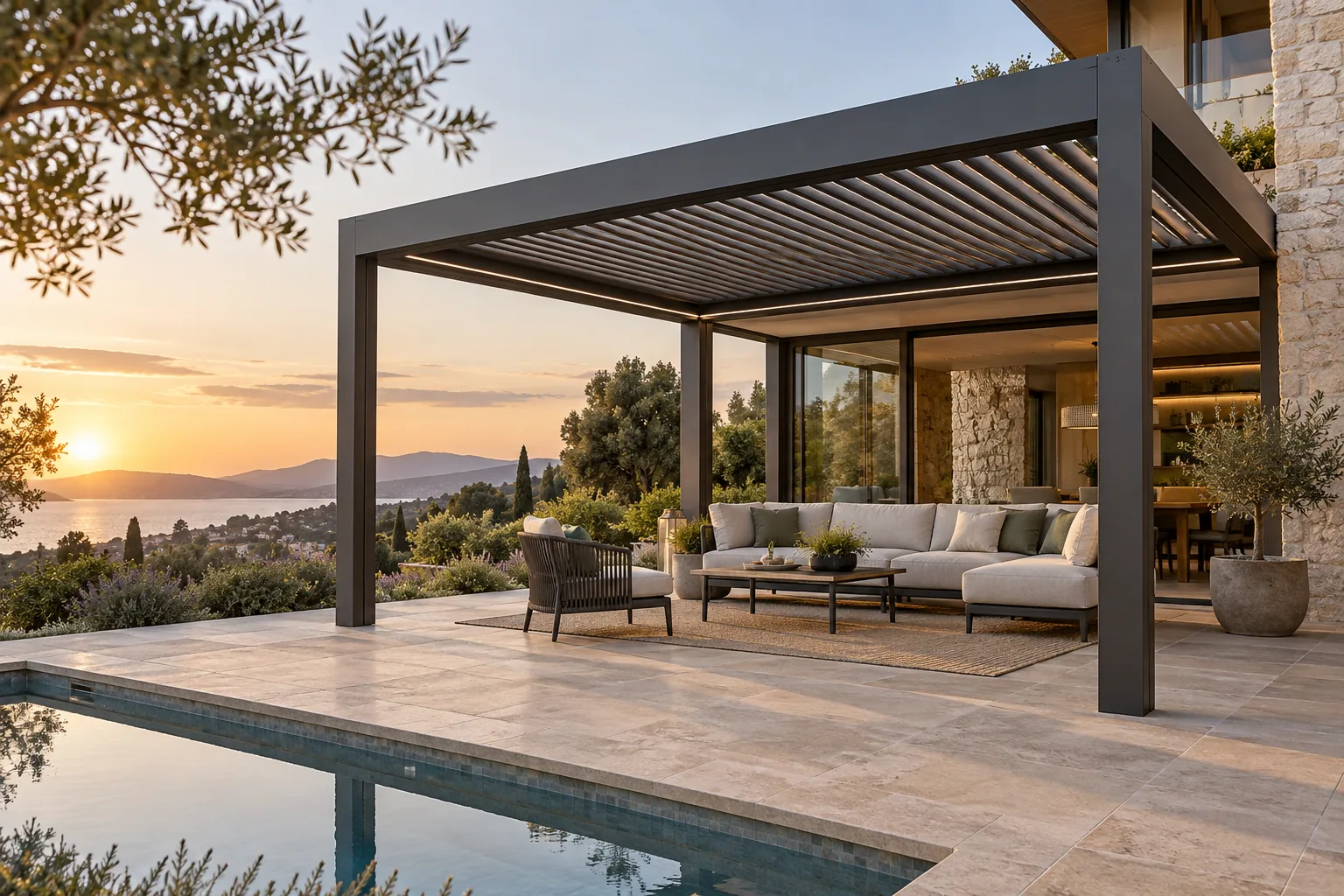
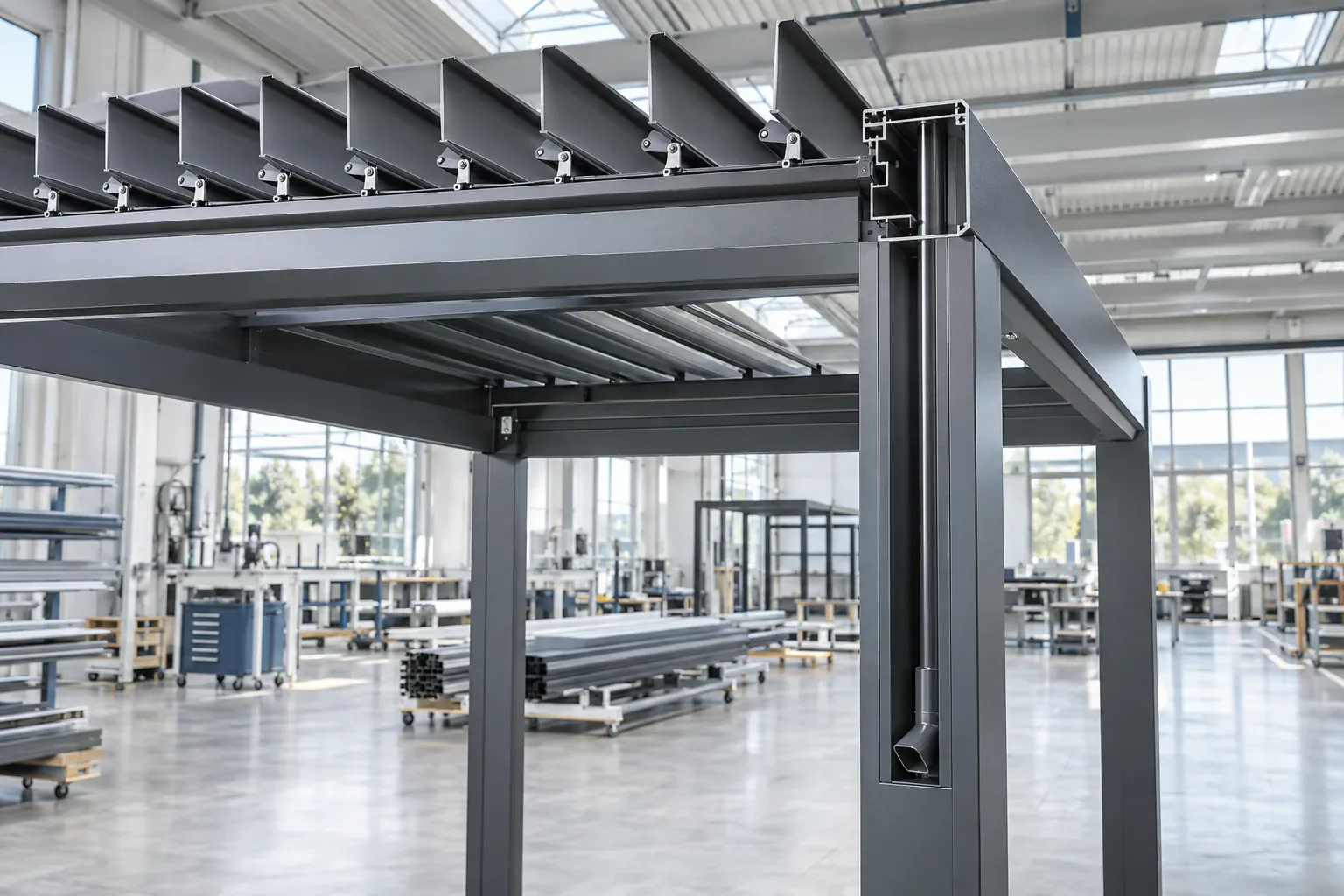
For an awning, identify the canopy, supporting arms or rails, storage cassette where provided and attachment locations. For the pergola, identify the beams, posts or wall connections, rotating blades and drive arrangement. The difference affects the visual result when the system is not providing shade. An awning may withdraw its fabric, while a louvered pergola retains its frame and blades overhead even when those blades are open. Neither arrangement is automatically better; each answers a different brief.
Write a shade brief that both suppliers can answer
Record when the terrace is used and where people actually sit. A breakfast table, an afternoon laptop seat and an evening entertaining area have different exposure patterns. Mark nearby windows, doors and reflective surfaces. The U.S. Department of Energy treats exterior shading as part of window-performance planning; that is useful context, but it does not establish a specific pergola energy-saving result. Keep claims about household energy bills separate from the outdoor comfort comparison.
Ask suppliers to show their proposed shade reach for the relevant times and season. With a fabric canopy, review projection, installation height and the required slope for the selected product. With rotating louvers, review blade direction and angle as well as roof projection. Neither the awning outline nor the pergola footprint establishes the occupied shaded area throughout the day. Low-angle light at an open side may require a separate response whichever overhead system is chosen.
Compare the view in both deployed and open conditions
A buyer may love the shade of a large canopy but dislike its effect on an upstairs view when deployed. Another may prefer the architectural presence of a permanent frame that defines an outdoor room. Evaluate the proposal from inside the house, from the terrace and from any important neighboring viewpoint. Request drawings showing the storage or open position rather than relying solely on the most attractive fully shaded rendering.
Consider how the system relates to doors and facade details. An awning cassette, a pergola beam or a wall connection can each compete with existing trim, lights and rainwater pipes. Keep clearances visible in elevations, and check the proposed installation height against the actual site. If the facade cannot accept the intended attachment, investigate a suitable alternative arrangement with the responsible professional instead of assuming that either category can be mounted wherever a photograph suggests.
Assess attachment and floor-space consequences
A folding-arm awning may be proposed without front posts, which can be attractive where the terrace edge must remain open. That arrangement transfers the attachment question to the supporting building; it does not eliminate structural responsibility. Other awnings use posts or guide structures. A freestanding pergola commonly introduces posts and foundations, while a wall-connected version introduces building interfaces. Compare the specific support diagrams rather than assuming all awnings are post-free or all pergolas need the same layout.
Place the support arrangement over a furniture plan. A post beside a dining chair or a route to the garden can matter more than the overall covered area. For an awning, check the deployed movement envelope and any interference with outward-opening doors or adjacent equipment. For either system, ask who surveys the substrate, who designs the fixings and what hidden conditions might change the quotation. Existing cladding is not evidence of a suitable structural attachment behind it.
Read the operating limits before comparing weather claims
Treat a fabric awning as a product with its own permitted use, not as a generic substitute for every roof. Some products address shade only; others describe particular rain conditions and installation requirements. Ask for the actual documentation, including restrictions and the required stored position in adverse weather. A louvered pergola also has configuration-dependent limits. Its rain-management design, roof position and drainage details need review rather than being inferred from a closed-roof photograph.
Do not rank unlike wind claims without understanding the tested arrangement, dimensions and installation conditions. A product rating does not by itself approve the supports at your site. Sensors may assist operation, but ask what they sense, what action they trigger, their power requirements and what happens if the system cannot move. Never use automation as a reason to disregard instructions or leave an unresolved severe-weather procedure for the installer to improvise at handover.
Check which accessories belong to the selected system
A defined pergola frame can provide locations for compatible lighting and side accessories, but compatibility must be confirmed for the model and module. An awning may offer integrated lighting or other options of its own. List each required function rather than treating the accessories shown in a catalogue as automatically included. If privacy is important, identify the exact opening to be screened and how the accessory changes everyday access, views and service requirements.
For motorized options, describe who uses the controls and whether local operation is needed alongside an app or remote. Establish responsibility for the electrical supply and commissioning. Ask how to isolate equipment safely for service and what the manufacturer prescribes for a power interruption. A simple, understandable control arrangement can be more useful than a long feature list, particularly in rental accommodation where the people operating the system may change frequently.
Compare service access and ownership cost without assumptions
Fabric, moving arms, blades, seals, motors and finishes have different care and replacement questions. Ask an awning supplier about canopy cleaning, drying before storage where required and the process for future fabric replacement. Ask a pergola supplier about blade movement, gutters, joints and access to drive components. Follow the actual instructions rather than applying a cleaning method from one product to the other. Confirm whether future service can be performed without dismantling unrelated landscaping or glazing.
For cost comparison, separate the supplied equipment from the completed site work. Record delivery, access equipment, building attachment or foundations, installation, power, commissioning and selected accessories. Then consider the service tasks you are prepared to carry out or purchase locally. No reliable universal price ratio follows from the words awning and pergola. A meaningful comparison is an itemized response to the same site, desired shade area and ownership expectations, with unresolved work clearly identified.
Use a short decision sequence before requesting a quotation
First decide whether the key requirement is shade that withdraws toward the building or an adjustable roof within a permanent outdoor frame. Next check the support possibilities and the occupied shade area. Only then compare accessories and finishes. This sequence prevents a feature-rich proposal from distracting attention from a basic mismatch, such as an attachment location that has not been reviewed or a storage position that conflicts with a window.
For a hypothetical compact terrace used mainly on calm summer afternoons, a documented retractable fabric awning may satisfy the brief with a visually open floor edge. For a terrace intended as a defined lounge with compatible side screening, a configured pergola may be worth investigating. These are starting points, not promises of suitability. Send both suppliers the same photographs and activity plan, request their limitations, and judge the complete proposals against your stated priorities.
COMPARISON
Compare the specified products; features vary within both categories.
Use this table to structure a discussion, not as project approval.
| Question | Louvered pergola | Retractable fabric awning |
|---|---|---|
| How does it adjust? | Blades rotate inside a retained frame | Canopy deploys and returns to a storage position |
| What remains visible? | Frame and blades remain overhead | Storage arrangement remains; deployed fabric withdraws |
| What supports it? | Configured posts and/or building connections | Building attachment and any product-specific supports |
| What needs servicing? | Roof mechanism, drainage, frame and accessories | Fabric, mechanism, attachments and accessories |
| What proves suitability? | Documentation for the actual model and site | Documentation for the actual model and site |
PROJECT CHECKLIST
Information to prepare
- Identify whether you mean a fabric awning or a framed retractable roof.
- Record the main occupied locations and hours when shade is needed.
- Review deployed, open and stored positions from inside and outside.
- Confirm the attachment substrate or required foundations.
- Obtain the actual weather-use and severe-weather instructions.
- Document sensor behavior and operation during a power interruption.
- Price accessories, electrical work and commissioning explicitly.
- Request cleaning instructions and a practical future replacement process.
COMMON PLANNING MISTAKES
Assumptions to avoid
- Treating every retractable product as the same roof mechanism.
- Assuming a post-free canopy needs no structural attachment review.
- Comparing nominal roof area rather than useful shade at occupied seats.
- Using a sensor description as a substitute for operating limitations.
- Comparing equipment-only and installed quotations as equivalent totals.
FAQ
Questions about pergola vs awning
Is a retractable awning the same as a retractable pergola?+
No. A retractable fabric awning deploys a canopy from a storage position. A retractable pergola roof operates within a defined supporting frame and may use a different roof material and collection arrangement. Ask for the exact mechanism, not just the word retractable.
Which gives more shade, an awning or a pergola?+
Useful shade depends on projection, height, roof geometry, sun position and where people sit. Compare both proposals at the same times and season. The nominal covered area is not enough to determine whether an exposed dining chair or sofa receives the intended shade.
Can a retractable awning stay open in rain?+
Only follow the selected product instructions. Some awnings are intended primarily for sun protection; others describe limited rain use with specified installation conditions. Ask for those limits in writing and do not extend them to severe weather or a different model.
Does a pergola always need front posts?+
Support arrangements depend on the selected system and project design. Review the actual support drawing, foundations and any building connections. Do not remove or reposition supports to achieve an open view without review by the responsible supplier and project professional.
Are both options available with motors?+
Motorized configurations exist in both categories, but the controls, sensors and power-interruption procedures vary. Confirm what is included in the quotation and who supplies power and performs commissioning. Do not assume that motorization establishes automatic weather protection.
Which comparison should come before price?+
Establish the required shade, opening behavior and feasible support arrangement first. Then compare complete scopes including installation, electrical work and selected accessories. A lower equipment price does not resolve a mismatch between the proposed mechanism and the way the terrace will be used.
SOURCES AND FURTHER READING
NEXT STEP
Review a pergola alternative
Send the terrace location, shade priorities and support constraints to discuss whether a configured louvered pergola fits your brief.
Review a pergola alternative